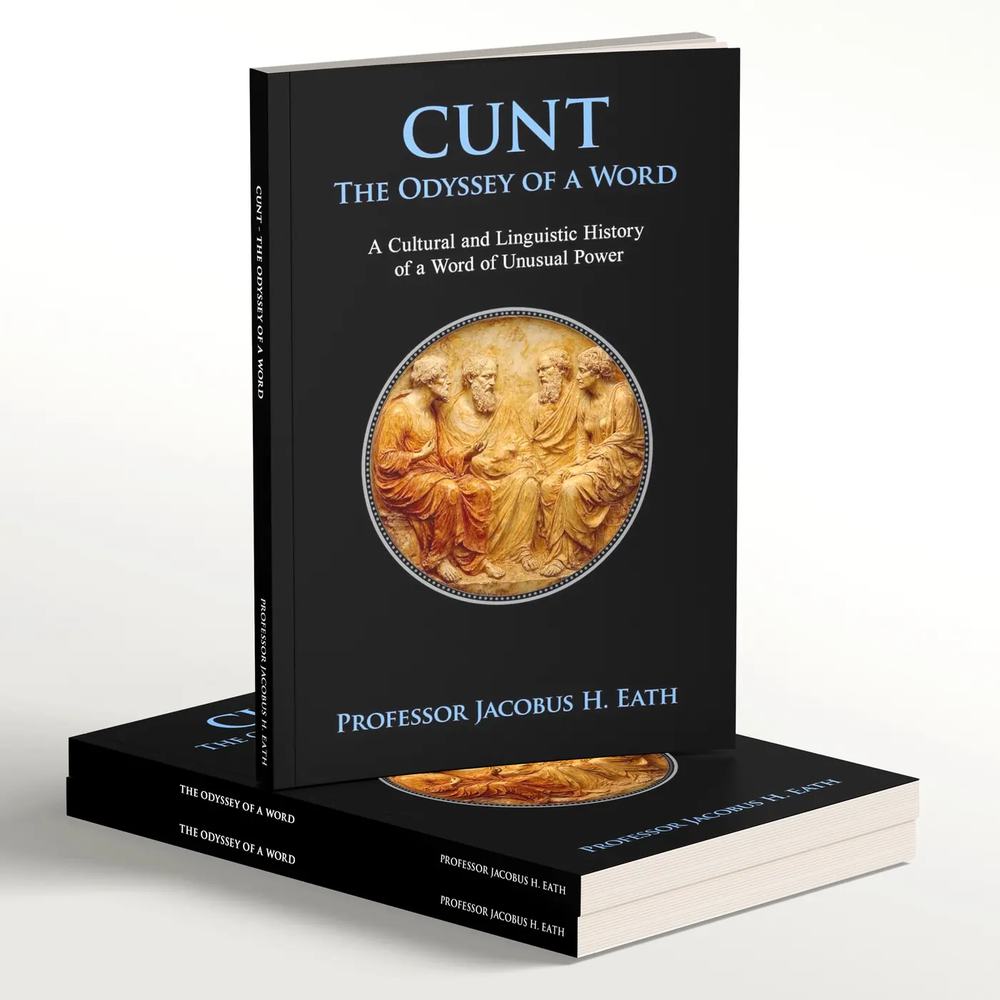
CUNT
The flagship rude gag gift book: high-risk, high-impact and very difficult to explain to polite relatives.
Word history
A plain-English guide to the meaning, origin, social risk and strange comic power of one of the most notorious words in the English language.
The C-word is usually a polite way of referring to cunt, one of the most notorious swear words in English. It can be used as an anatomical term, a direct insult, a comic exaggeration, a term of rough affection, or a word so severe that the whole conversation stops. That range is exactly what makes it difficult to explain and very easy to misuse.
In Britain, Ireland, Australia and New Zealand, the word is more culturally visible than it is in many American settings. That does not mean it is harmless. It means the word has a wider social life: pub insult, football-terrace abuse, comic punchline, private joke, and genuine verbal grenade.
Most people use “the C-word” because saying the word itself can feel too blunt. The underlying word is cunt. Historically it has been connected with female anatomy, but in modern use it is often detached from that literal meaning and used as a general insult. That is part of the problem: the word can be used casually by one person while sounding deeply aggressive or misogynistic to another.
The exact meaning depends on delivery. Said flatly at a stranger, it is usually hostile. Said between close friends in a specific British or Australian comic register, it may be intended as rough affection. Written across the front of a book in solemn classical styling, it becomes something else again: a joke about language, offence and fake academic seriousness.
That is the central tension behind CUNT: The Odyssey of a Word. The word is not softened. It is placed in a setting that looks scholarly, ancient and absurdly respectable. The joke comes from the collision between the most socially dangerous word in the collection and the pompous seriousness of the presentation.
The C-word is offensive for more than one reason. It is sexually explicit, it has a long taboo history, and it is often heard as misogynistic even when the speaker claims to be using it as a general insult. Unlike milder British insults such as wanker, tosser or bollocks, this word can change the temperature of a room instantly.
Its power also comes from scarcity. Many swear words have been worn down by constant everyday use. The C-word has not fully lost its shock. It still feels like a line has been crossed, especially in formal settings, family settings, workplaces, mainstream advertising, schools, public-facing retail and polite conversation.
The same word does not carry exactly the same social force everywhere. That is one reason people search for it: they hear it in a British TV show, Australian comedy, a football clip or a viral argument and cannot quite tell whether it was meant as an insult, a joke or both.
| Place | Common perception | Practical warning |
|---|---|---|
| United Kingdom | Known, powerful and sometimes used comically, but still one of the strongest words available. | Do not assume pub usage means workplace usage is safe. |
| United States | Often treated as especially severe, misogynistic and socially explosive. | Higher risk than many British speakers expect. |
| Australia and New Zealand | More common in some informal speech and comedy, sometimes used with affection. | Still depends heavily on audience, tone and setting. |
| Online culture | Often stripped of context and used for maximum reaction. | Text removes tone. What sounded funny out loud can read as abusive. |
The C-word has old roots in English and has appeared in forms connected with medieval language and place names. Its exact route through English is not tidy, and anyone pretending there is one neat origin story is probably overselling it. What is clearer is the broad journey: a blunt bodily word became increasingly taboo, then became one of the most charged insults in modern English.
The word’s long life is one reason it suits The Odyssey of a Word. The series treats rude words as if they deserve antique reverence: false gravitas, mock scholarship, chapter headings, faux historical grandeur and the sort of tone normally reserved for dusty manuscripts. The more indecent the word, the better that joke works.
As a gift, the word has immediate force. You do not need to explain the joke. A person unwraps a respectable-looking paperback, sees the title, and the room does the rest. That is why CUNT: The Odyssey of a Word is the most explosive title in the series.
It is not the safest option. For many recipients, WANKER, DICKHEAD, BOLLOCKS or BASTARD will land more comfortably. But if the recipient has the right sense of humour, the C-word title has unmatched impact.
The flagship rude gag gift book: high-risk, high-impact and very difficult to explain to polite relatives.
The C-word is usually a way of referring to cunt without saying it directly. It is one of the strongest and most taboo swear words in English.
No word is heard in exactly the same way by every person, but the C-word is always high-risk. It can be funny among close friends and deeply offensive in other settings.
Because it creates instant impact. The book looks serious, classical and scholarly, then the title destroys that impression immediately.